Elite Pressure Blogging

Posts Tagged ‘deck staining’

Some of the reasons Behr Deck Stain is a Bear!

Wednesday, August 11th, 2010

I have briefly listed the issues I have faced with Behr stain. These issues are from experiences in performing over 3000 deck cleanings and stains per year and over 16 years experience.
-Difficulty in application
-Uneven appearence of stain on new wood
-Black residue on deck surface within short period of time (in certain conditions)
-Extreme diffficulty in stripping old stain
-Confusing labeling of products
-Formula changes of product which create difficulty in matching color and protecting in future applications.

I realize Behr is highly rated on Consumer Reports. I am a big fan of CR, however much of CRs ratings are based on volume sold. Behr is sold at Home Depot. Without effort they should be the #1 sold brand of deck stain. This does not make Behr the best deck stain. I still prefer oil stains for semi transparent colors: Olympic, Cabot, Benjamin Moore, Ready Seal or even Super Deck. Happy Decking!

Does my new deck need to be pressure washed before it is treated?

Thursday, October 22nd, 2009

Most people believe that because the wood is new, there is no prep work needed before staining or painting. Fact is unless the new wood is properly prepared, any finish you put on the deck will not give you maximum performance.

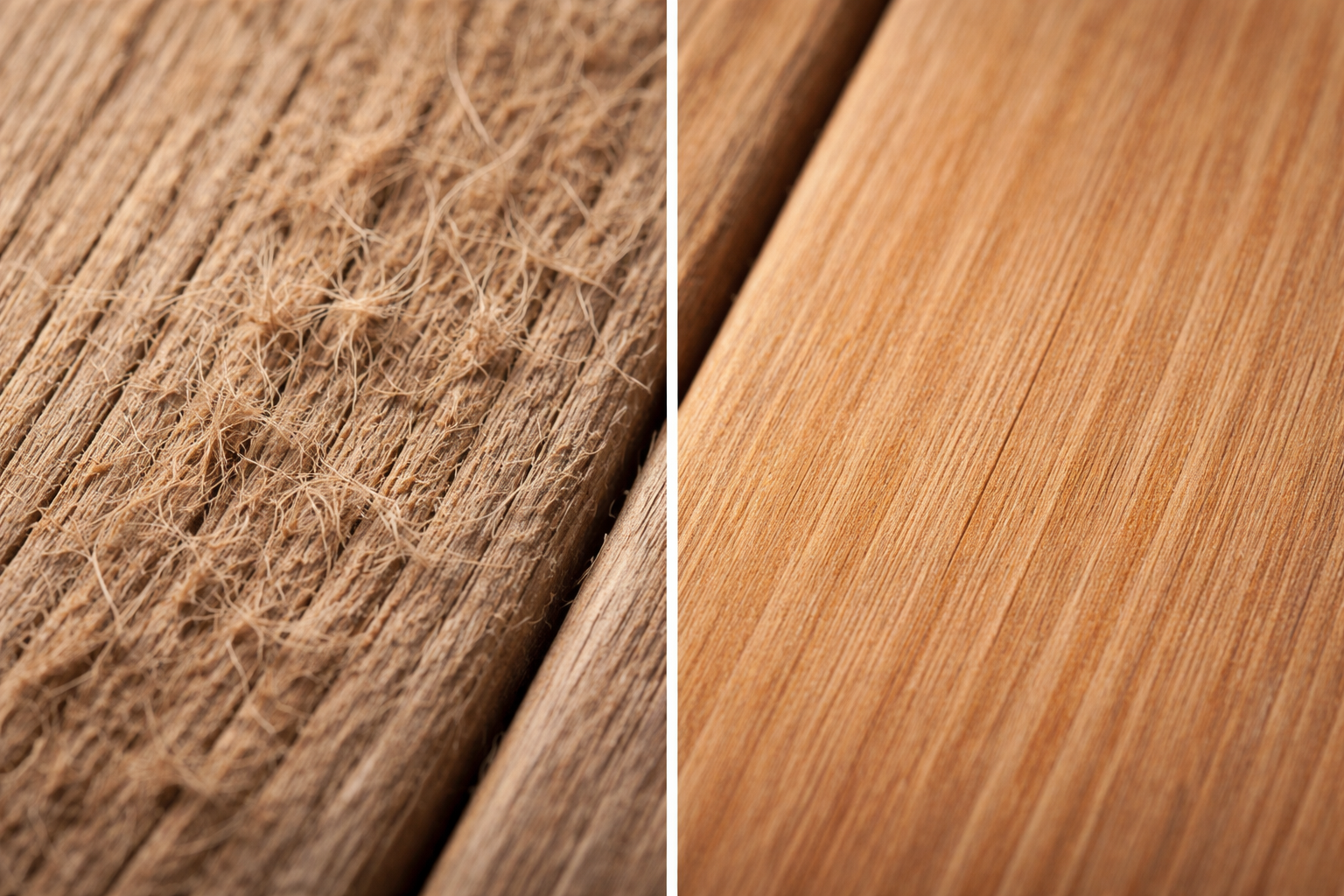
New wood as it comes from the lumber mill has been sawn and planed with high speed equipment. As the wood is finished the heat and pressure from the blades compressed the wood fiber on the surface which gives the wood a shiny appearance. This is “mill glaze”. Stains and paints will not properly penetrate the surface of the wood as long as there is mill glaze (Bill Swanston, Benjamin Moore).

Prior to applying any coating to the wood the mill glaze must be removed. For this you have three options. Leave the wood out for two to three months so the rain and sun can get at it (still it will need to be cleaned before it is treated after all you would not wax a dirty car). Option two is to sand the lumber with the grain with 80 grit sand paper. The sand paper will cut into the surface removing the mill glaze and also any loose wood fibers and slivers. The third option is a chemical solution and a light pressure wash. Now that you have all the lumber prepped, no mill glaze is present, we now can look at staining or painting if preferred.

Put your wood deck in check

Thursday, September 17th, 2009

Fairfax County Times
Homes Section
March 26, 2009

By Steve Chapman
Special to the Times

As you step outside onto your deck one sunny, spring day for the first time this year, you may gasp at how gray it looks. Before you dump out your piggy bank to build a new deck, consider a less expensive alternative.

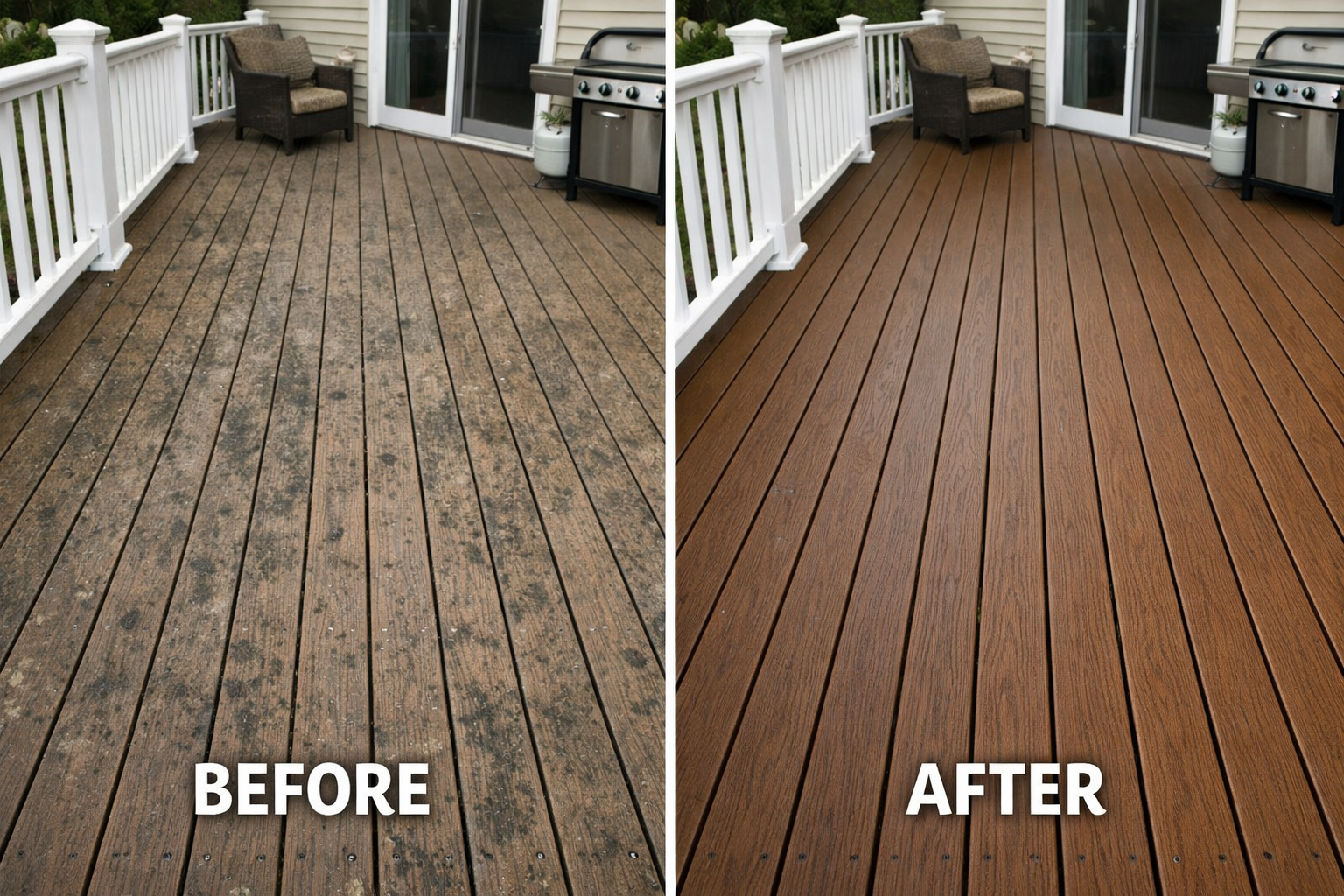
Most likely your deck looks much worse than it really is. A simple pressure washing and treatment can work magic. Within hours, your old, sad-looking deck will be all “decked out” for parties, graduations, weddings or barbecues this spring, summer and fall. Here are a few simple tips to keep your deck in check:

Q: What type of equipment should I use?
A: Use a pressure washer that is at least 2,500 pounds per square inch (psi) and uses three gallons per minute. The psi will ensure the machine is strong enough to clean and rinse your deck. Wood is soft. You don’t want to blast it too hard. This can damage your deck and siding and injure you if you’re not careful.

Q: What kind of cleaning agents are there?
A: Choose a non-bleach cleaning agent. It will loosen the dirt, mold and mildew from wood so the process is more rinse and less blast. Bleach will degrade the wood fibers in your deck.

Q: Where should I start cleaning my deck?
A: First, remove all furniture. Be sure you cover the siding and shrubbery with tarps or plastic. Trust me, you’ll be glad you took the time to protect these items and not have to clean up afterwards. I suggest if you have a cement patio or driveway, that you start there to practice using the pressure washer. Then start on your deck’s floor first. Wash in a pendulum motion, back and forth, going with the wood grain. After you finish the floor, start on the rails.

Q: Should I use a seal or stain?
A: A treatment can only be applied to your deck after it’s completely dry. I suggest waiting three to five days. Don’t start if it’s windy or rain is in the forecast for the next day. Sealants are clear; stains have color. A clear sealant will help protect your deck for a year, where as a stain will protect it longer. Before you begin, insect your deck for popped-up nails and cracked or warped wood fix them. I always sand handrails to help ensure there are no splinters.

Steve Chapman is the owner of Elite Pressure Cleaning in Manassas. He can be reached at shchapman77@aol.com

Deck Cleaning/Staining Schedule

Friday, April 3rd, 2009

More questions from our customers on staining…

Q: Once the initial cleaning is done, then I guess you would come back twice more to complete the rail sanding, board replacing, and staining part, but that depends on the weather, right?
A: Yes, Staining is weather dependent. The technician who will do your board replacements I will try and schedule him to do the washing as well so he could do both parts at once. The stain would be performed later after the deck has dried.

Q: I know the deck has to dry completely before you do the stain. And is it warm enough this time of year to apply the stain, or will it be by mid-April?
A: We have been busy staining all through March. The main concern is wind, rain, above 50% and dampness on the deck.

Q: I’m not sure what the temperature range is for applying the oil stains. If there are different color choices from Benjamin Moore, do you have samples you can bring on Monday for us to choose from?
A: Benjamin Moore offers many different colors. We have found that the colors we offer are the most popular, the other colors are a slight variation from these colors, and because they are semi- transparent the same colors look a bit different on every deck due to age, positioning and prior treatments in the wood.

Benjamin Moore stains

Friday, April 3rd, 2009

The following are some excellent questions (and our answers) from one of our clients, regarding the stains we use.

Q: Are the four colors shown on your website the ones from Benjamin Moore?
A: The colors on the website and our brochure resemble the colors from Benjamin Moore. Our colors are custom made because throught the years, we have found customers wanting more brown or more red in a color, we took these comments into consideration when we created the colors. Colors look a bit different on every deck depending on the amount of sun and shade as well as the condition of the wood. I have never had a problem with a customer after the fact saying they wanted a different color because the colors are both popular and distict.

Q: What is it about that brand that you think is the best?
A: Over the years I have done extensive research and focused my research on two aspects of a stain. The percentage of solids and the quality of resins which make up the solid part of the stain. A clear seal will typically have betwen 8-11 percent solid. Brands such as Behr, Flood and Olympic, TWP and Ready Seal and big box Cabot have about 35% solid where as Specialty store Cabot, Sikkens, ABR and Benjamin Moore have between 55 and 60 percent solid. The solid ensure that there is more substance remaining on your deck rather than absorbing into the atmosphere. As far as the second part of my research, the quality resins found in both Benjamin Moore and Sikkens were superior for longevity of color and durability of the stain. (Basically the resins they use cause the deck to look better longer).

We use Benjamin Moore over Sikkens and Cabot for several reasons: When Cabot went into Lowes they diluted both their product and brand name people dont know the difference between the two products a big box and specialty store and I dont feel it is our job to defend or advocate for Cabot when there is a simpler to use a better alternative (Ben Moore). In regard to Sikkens, it looks great, but the maintence is horrendus (every year or else costly repairs in way of sanding and chemical treatment). Sikkens is also more labor intensive to apply and the product is twice as expencsive.

Q: What type of stain is it — a penetrating oil based, or something else?
A: It is a Semi transparent so you can see the grain of the wood through the stain. It is a penetrating oil so it will protect your wood from the inside out.

Q: If we had sealant put on it each year after it was stained, would that help to make the color last longer?
A: A seal will keep water from pentrating the wood, but so should the stain if it is applied every 3 years. Before you applied a sealant you would need to wash the deck prior to the sealant being applied. Think of it like waxing a car, you would want to wash it first or you will wax in the dirt. However, when you pressure wash the deck you may remove some of the stain. So it would be my reccomendation to wash it and stain it every 3 years. If you have alot of trees that turn the deck green then a light pressure washing maybe a year and a half into the three years for esthetic purposes only.